
Venezuela News: U.S. Strikes, Capture of Nicolás Maduro, Global Reactions & Ongoing Developments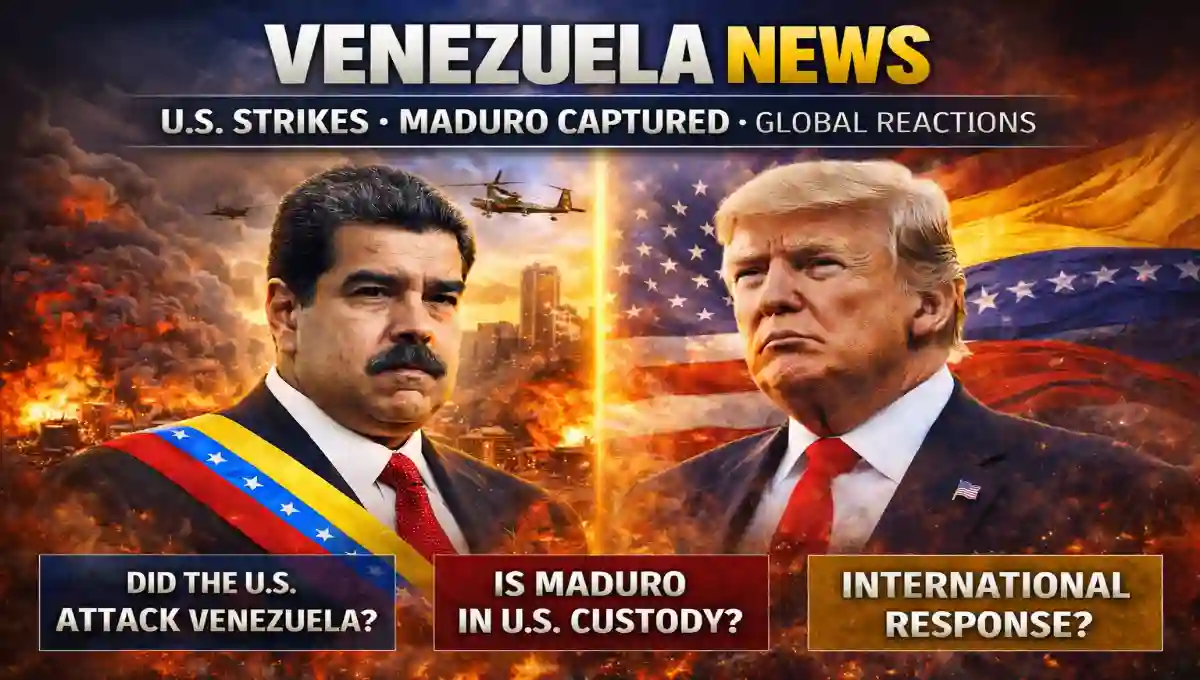
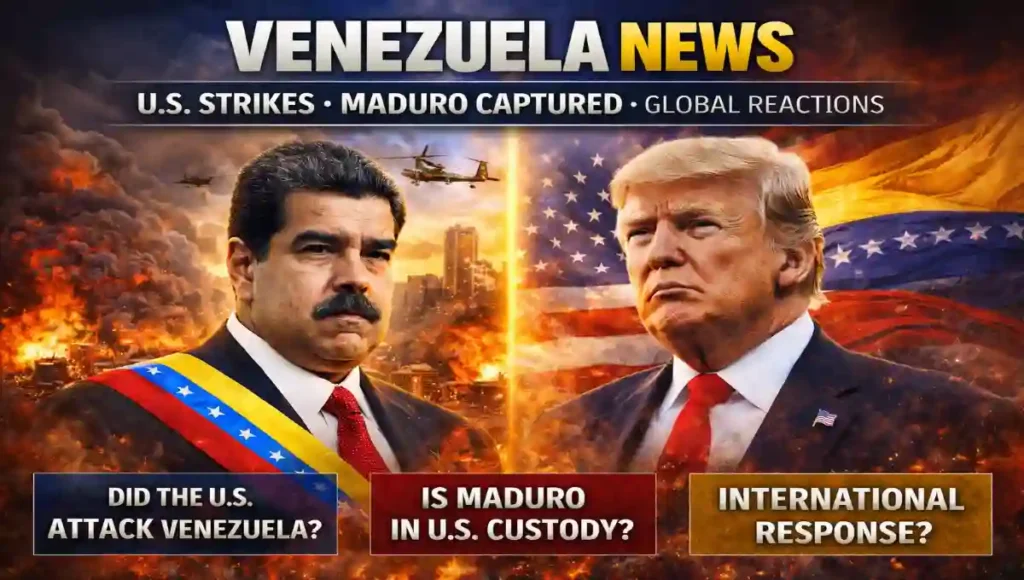
In a dramatic escalation of U.S.–Venezuela tensions, the United States carried out a series of military strikes inside Venezuela in early January 2026 that targeted key installations in and around the capital, Caracas. According to official statements from Washington and reporting by multiple international media outlets, Venezuelan President Nicolás Maduro and his wife, Cilia Flores, were captured by U.S. forces and transported to the United States. These developments have sparked worldwide debate on legality, sovereignty, regional stability, and international law.
This article provides a comprehensive and accurate update on the events, verified reactions from around the world, and contextual analysis of what this might mean for Venezuela, the region, and global geopolitics.
The Military Operation in Venezuela
On January 3, 2026, U.S. military forces initiated a coordinated operation involving air and ground elements that struck multiple targets in the Venezuelan capital and surrounding regions. Venezuelan authorities reported that a series of explosions shook Caracas and other states, and videos circulated globally showing aircraft over the city and infrastructure damage.
U.S. President Donald Trump described the mission as a “large-scale strike” designed to dismantle what he called an institutionalized criminal network and to remove Maduro from power. Trump also stated that Maduro and his wife were taken into custody and were being flown to the United States, where they would face charges related to alleged narcotics and terrorism conspiracies.
This operation, referred to by some sources in reporting as “Operation Absolute Resolve,” involved extensive planning over months, including intelligence coordination, surveillance, and strategic positioning of U.S. military assets — notably air and sea platforms in the Caribbean. Analysts say these pre-strike maneuvers underpinned the surprise and scale of the action.
Explosion Accounts: Multiple explosions were reported in Caracas early on January 3, with local journalists and residents describing blasts and subsequent blackouts across parts of the city.
Who Is Nicolás Maduro?
Nicolás Maduro has been a central and polarizing figure in Venezuelan politics for more than a decade. He succeeded Hugo Chávez following Chávez’s death in 2013 and has since led a government that many international critics have described as authoritarian. Maduro’s leadership has been marked by economic collapse, hyperinflation, mass migration, and persistent political turmoil. Opponents and several governments, including the United States and members of the European Union, accused his administration of stifling democratic processes and manipulating elections.
The 2024 presidential election in which Maduro was declared the winner was contested by opposition leaders and criticized by international observers for lack of transparency. Tensions with the U.S. government increased further following sanctions and legal actions aimed at undermining his leadership and challenging the regime’s control over oil and state revenue.
Legal Context and International Controversy
U.S. officials have argued that their actions in Venezuela are grounded in efforts to combat narcotics trafficking, terrorism, and threats posed by illicit networks allegedly linked to the Maduro government. Trump’s administration has previously designated Venezuelan drug gangs, including the “Cartel of the Suns,” as Foreign Terrorist Organizations — a designation that shaped the legal narrative supporting intervention.
However, international legal experts and major global institutions have criticized the operation as lacking legal authorization under international law. A detailed analysis from the London-based Chatham House argues that the capture of a sitting head of state and military strikes inside a sovereign nation without a United Nations mandate likely constitutes a severe violation of international sovereignty and the UN Charter.
Legal Force Debate: According to international law analysts, there is no clear United Nations authorization for the use of force by the United States in Venezuela, raising questions about the legality and precedent such actions set.
Such interventions were historically rare without Security Council approval, and the global community remains sharply divided over whether the purported motives — including drug interdiction and regime removal — justify this level of armed engagement.
Government and Military Structures in Venezuela after the Strike
Following the removal of Maduro from power, Venezuelan constitutional mechanisms were invoked to appoint interim leadership. Vice President Delcy Rodríguez was granted presidential powers by Venezuela’s Supreme Tribunal of Justice to ensure continuity of government and national defence. Rodríguez has publicly denounced the U.S. operation as an illegitimate act of aggression and reiterated Maduro’s position as the country’s rightful president despite his detention abroad.
The internal Venezuelan political landscape remains deeply fractured: some opposition figures have expressed openness to transitional governance, while grassroots support for Maduro’s movement persists, underscoring the uncertainty ahead.
International Reactions
The U.S. military action and capture of Maduro have prompted a spectrum of global responses:
- Brazil: Brazilian President Luiz Inácio Lula da Silva condemned the U.S. intervention, calling it an “unacceptable line” crossed and a violation of sovereignty, urging the United Nations to respond decisively.
- China: Beijing demanded the release of Maduro and his wife, characterizing the U.S. action as a breach of international norms and urging diplomatic dialogue instead.
- Australia: Prime Minister Anthony Albanese called for a peaceful democratic transition in Venezuela and expressed concern over international law violations, also advising citizens against travel to the region due to security risks.
- UN and International Officials: Reports indicate the UN Security Council plans emergency discussions on the situation, reflecting broad global alarm over the use of force and implications for international order.
Reactions from Latin American nations have been particularly varied, with some condemning U.S. intervention as neocolonial aggression, while others criticize Maduro’s governance and advocate for a negotiated political resolution.
Economic and Oil Industry Implications
Venezuela holds some of the world’s largest proven oil reserves, and its role in the global energy market has historically been significant. U.S. tensions with Caracas over oil nationalization and revenue control long predated the latest strikes, including sanctions and tanker seizures aimed at curtailing Maduro’s economic base.
Industry analysts are closely watching oil output, market reactions, and potential shifts in production policy. Disruption to Venezuelan oil infrastructure could have implications for global crude pricing, energy security, and investor sentiment — especially in a landscape already strained by geopolitical instability.
Potential Regional and Refugee Consequences
The operations have raised concerns about further displacement of Venezuelans who have fled economic turmoil and instability over recent years. Trend analyses suggest that millions have already left the country, seeking refuge in neighbouring states and beyond. Any intensified conflict or governance vacuum could exacerbate migration flows, creating additional pressure on regional partners.
Neighboring countries like Colombia and Brazil, already dealing with inflows of migrants, will likely remain at the forefront of humanitarian responses. International organisations including the United Nations High Commissioner for Refugees have called for coordinated assistance and discussions on border support systems.
What Comes Next?
The immediate political landscape in Venezuela is unsettled. While Maduro’s capture signals a major shift, governance challenges, internal legitimacy debates, and negotiations between U.S. authorities and Venezuelan actors will shape outcomes. Analysts note that temporary governance arrangements under interim leadership may not bring consensus or stability without broader international and domestic support for a peaceful transition.
Legal battles in U.S. courts — especially around charges against Maduro and Flores — are also imminent, raising complex issues about jurisdiction, diplomatic immunity, and international law.
Geopolitically, this event may redefine U.S. foreign policy in Latin America, influence regional alliances, and potentially prompt future diplomatic realignments. Observers will monitor reactions from global powers such as Russia, China, and the European Union as well as the United Nations’ role in mediating and responding to the crisis.
FAQs
Did the United States attack Venezuela?
Yes. In January 2026, the United States conducted military strikes in Venezuela, including around Caracas, and captured President Nicolás Maduro and his wife, an action described by the U.S. as a large-scale operation against criminal networks.
Is Nicolás Maduro currently in US custody?
According to U.S. President Trump and multiple international news reports, Maduro and his wife were taken into custody and transported to the U.S. where they face legal charges.
Has a war been declared between the U.S. and Venezuela?
There is no formal declaration of war; however, military operations and strikes represent a significant escalation. International law experts dispute the legality of such actions.
How has the international community responded?
Responses have been mixed: several nations condemn the U.S. action as a breach of sovereignty, while others focus on political reform in Venezuela. Emergency meetings and diplomatic pressure are underway.
What might happen to Venezuela’s oil industry?
Venezuela’s oil sector, previously targeted through sanctions and tanker seizures, faces uncertainty as political control and production may change under interim governance.
Also Read: Big Bash League 2025-26 Schedule, Teams, Venues, Format & Results